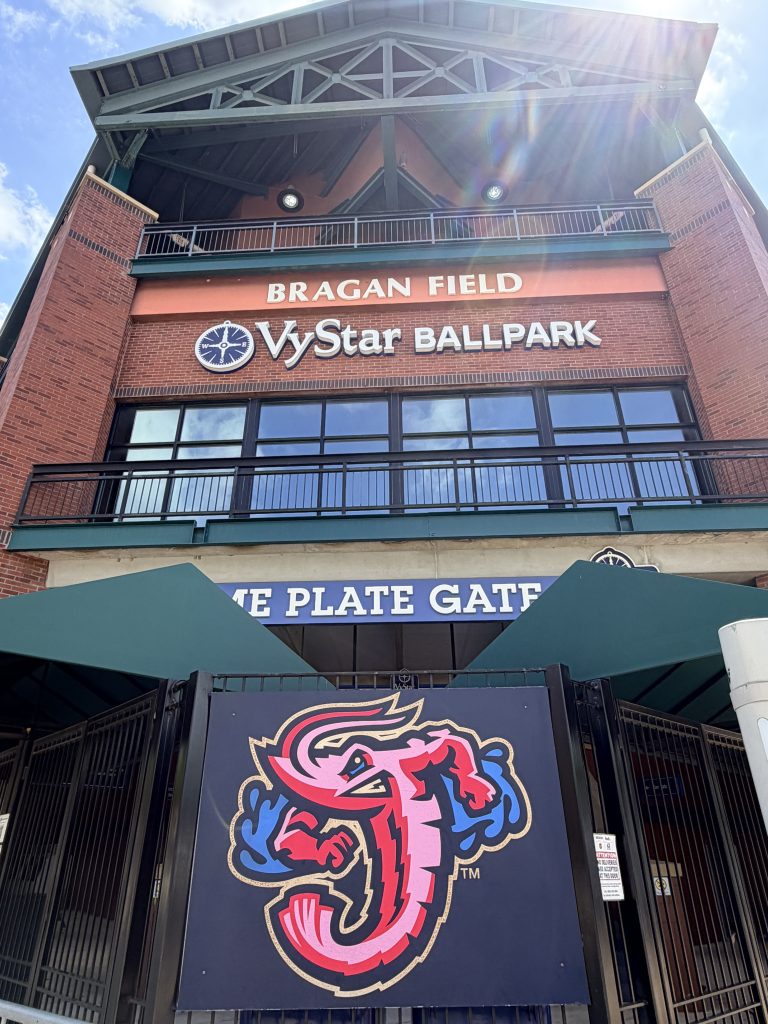
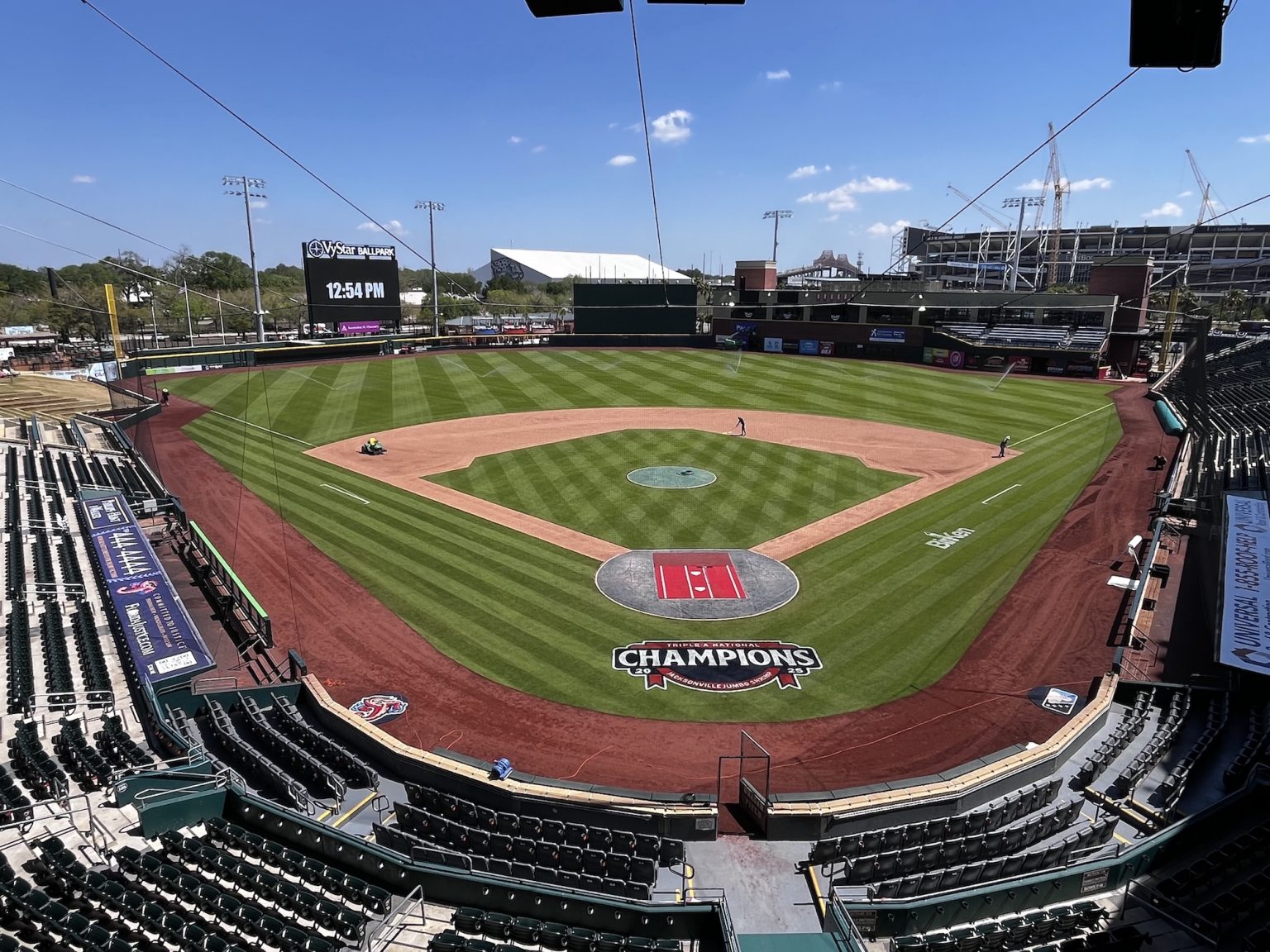
When the Jacksonville Jumbo Shrimp opened their 2026 season at VyStar Ballpark in Jacksonville, Florida, few fans could have guessed the field had been installed just weeks earlier during one of the coldest stretches of weather the city had experienced in years.
Today, the Platinum TE Paspalum playing surface is drawing rave reviews from players, coaches, visiting teams, and industry professionals alike. For Field Manager Joshua Leo, the successful conversion to Platinum TE has reinforced what he already believed: the right turfgrass can make all the difference.
A Vision for Better Turf
Leo took over management of the field in 2024 and quickly identified opportunities for improvement.
The previous playing surface consisted of Tahoma 31 Bermudagrass, but Leo felt the stadium needed a turfgrass that could deliver greater density, improved playability, and better performance during Jacksonville’s long baseball season.
“I believed we needed a higher quality turfgrass,” said Leo. “We needed a denser canopy and better overall quality.”
His confidence in Platinum TE came from firsthand experience. While working with the Pittsburgh Pirates organization, Leo regularly visited Pirate City in Bradenton, Florida, where Platinum TE has been successfully used. He had also observed the turfgrass at CACTI Park, the spring training home of the Houston Astros and Washington Nationals in West Palm Beach.
What he saw convinced him that Platinum TE was the right choice for Jacksonville.
Racing the Calendar
The field renovation included a new engineered root zone consisting of 95% sand and 5% playing silt. Once the new profile was in place, the Platinum TE sod supplied by Pike Creek Turf was installed on January 16.
Unfortunately, Mother Nature had other plans.
A record-setting Arctic cold snap arrived just as the project was underway. Freezing temperatures and even snowfall created conditions that were far from ideal for establishing warm season turfgrass.
To protect the newly installed sod, Leo and his team deployed grow blankets for several weeks after installation.
“We used the grow blankets over the course of the first six weeks,” Leo explained. “They kept the wind off the new turfgrass and created a greenhouse effect.”
The challenge was significant. The first event of the year was scheduled for February 19, leaving barely a month for the field to establish.
Bruce Allison of Pike Creek Turf remembers the concern surrounding the tight timeline.
“With a major college baseball event scheduled for February, we were very concerned there would be insufficient time to complete the project,” said Allison. “The contractor ultimately installed the grass in mid-January during some of the coldest days of the year. We were convinced it would not have sufficient time and warmth to get established for play; Josh proved us wrong.”
Allison credits a combination of intensive management and the quality of the Platinum TE sod for the successful outcome.
“Through the use of grow blankets and intense management and helped by the high quality and viability of the Platinum TE sod, he successfully met the deadline,” Allison said. “The field turned out great, the tournament went off without a hitch, and it continues to improve daily. Kudos to Josh and his team on a job well done.”
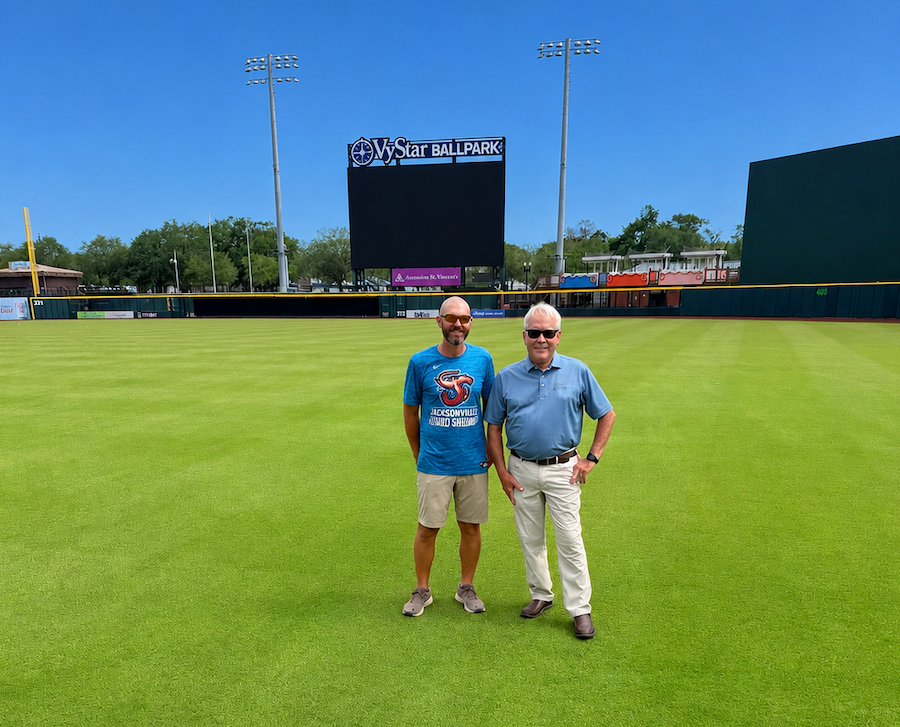
Deep Roots, Fast Establishment
One of the biggest surprises came below the surface.
By the first day of play, Platinum TE had already developed approximately three-inch roots—more rooting than Leo had previously observed with mature Bermudagrass on the field.
“The turf had three-inch roots on Opening Day,” Leo said. “That’s more than we ever had with the previous grass.”
“The turf had three-inch roots [in one month]. That’s more than we ever had with the previous grass.”
Joshua Leo, Field Manager at VyStar Ballpark
The rooting has only continued to improve.
Today, roots have penetrated through the root zone and into the gravel layer beneath. During recent inspections, Leo noted that roots were still extending beyond the six-inch plugs being pulled from the profile.
“For sports fields, roots are important,” he said.
That aggressive rooting has translated into exceptional footing, stability, and durability—critical characteristics for a facility that hosts far more than just professional baseball.
The Jumbo Shrimp play 75 home games each season, while the stadium also hosts college games, high school games, movie nights, charity events, and other community activities throughout the year.
A Surface Players Love
Perhaps the most important measure of success is how the field performs during competition.
According to Leo, the feedback has been overwhelmingly positive.
“We’ve received lots of positive comments from players, visiting players, and coaches,” he said. “Many of them say it’s the best playing surface they’ve encountered in their entire career.”
Leo attributes much of that performance to Platinum TE’s finer leaf texture.
“The ball plays more true,” he explained. “We don’t see as much snaking on ball roll. Regardless of the mowing pattern, the ball roll is smooth and true.”
The playing surface speed is another advantage.
“We’ve received lots of positive comments from players, visiting players, and coaches. Many of them say it’s the best playing surface they’ve encountered in their entire career.”
Joshua Leo, Field Manager at VyStar Ballpark
“The turfgrass plays quick, which our team likes,” Leo said. “The speed of the ball off the grass doesn’t get slowed down very much.”
In addition to excellent playability, Platinum TE has delivered aesthetic benefits that have attracted attention well beyond Jacksonville.
In fact, during a recent visit, representatives from the Worcester Red Sox—the Triple-A affiliate of the Boston Red Sox—were stunned by the field’s appearance.
“One of their representatives looked at it and asked how long we’d had artificial turf,” Leo said with a laugh.
For a natural grass field manager, there may be no higher compliment.
Built for Performance
Beyond appearance and playability, Leo appreciates Platinum TE’s management advantages.
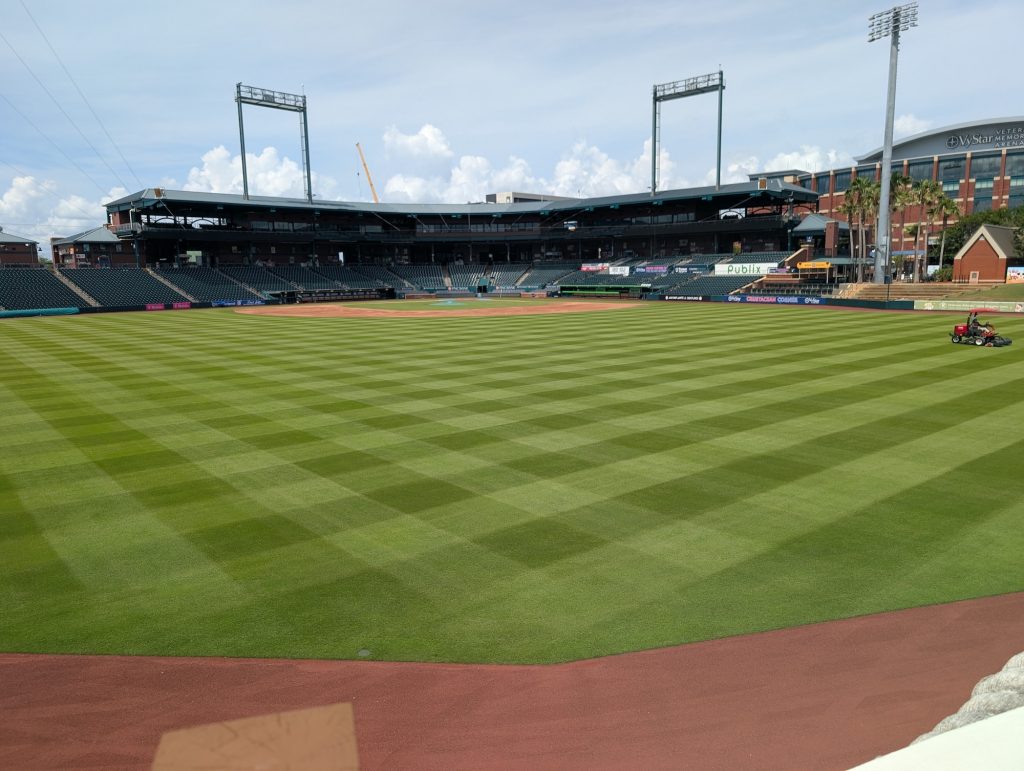
The turf recovers quickly from cultivation practices, tolerates wear exceptionally well, and resists the hot spots that challenged previous turfgrass varieties. Cleat marks rarely scalp the surface, and the dense, leafy canopy quickly recovers from traffic.
Most importantly, Platinum TE has delivered exactly what Leo envisioned: a durable, high-performance surface capable of standing up to the demands of professional sports.
“We couldn’t be happier with the Platinum TE,” he said.
Just a few weeks after installation during record cold weather, the field was ready. Months later, it continues to perform at an elite level—a testament to Platinum TE’s rapid establishment, exceptional rooting ability, and proven durability under the pressures of athletic field use.